


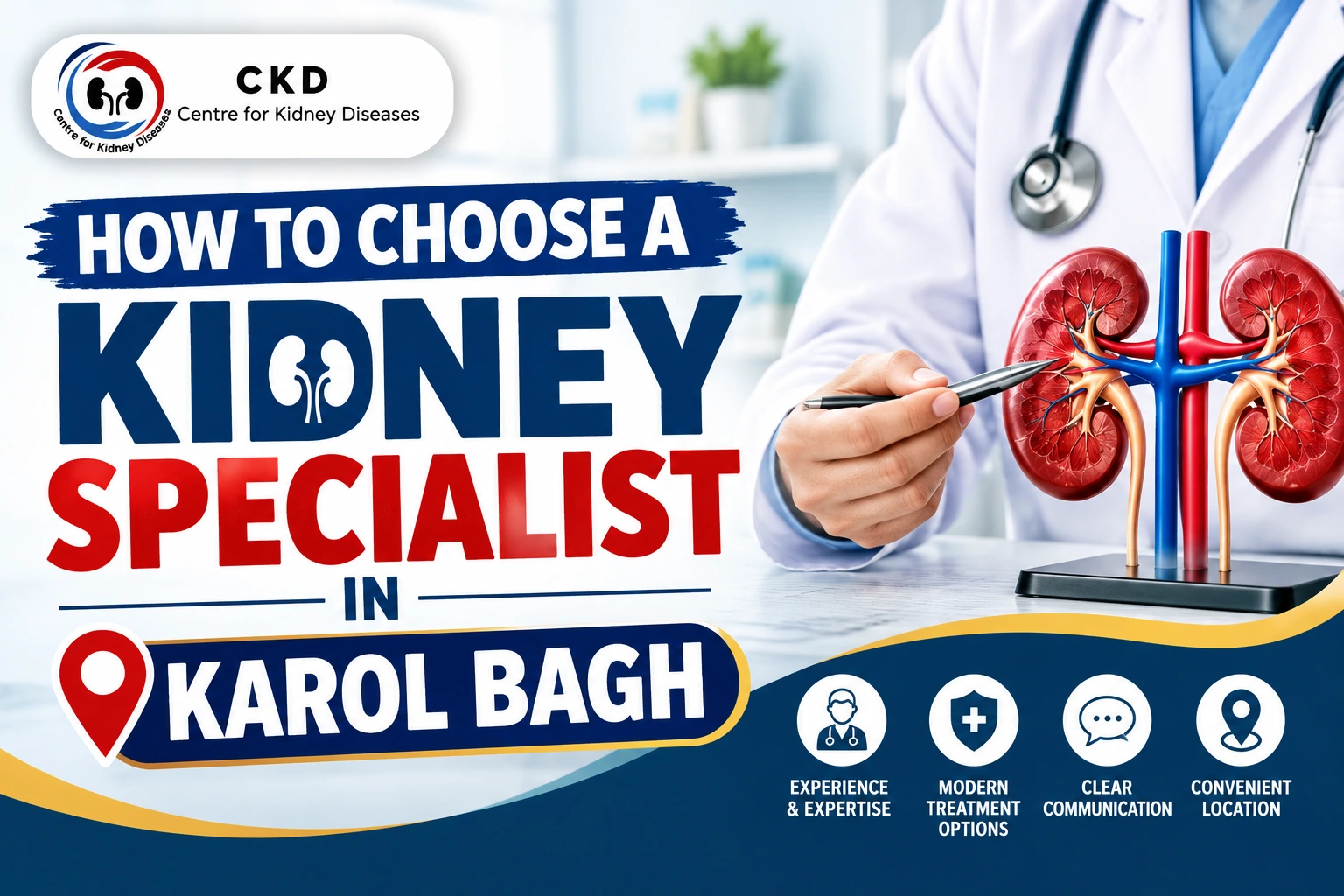
How to Choose the Right Kidney Specialist in Karol Bagh
If your doctor has just used the words "creatinine is a bit high" or "let's keep an eye on your kidneys," you're probably not thinking about SEO or star ratings. You're thinking: who do I actually go see about this? And if you live around Karol Bagh, Patel Nagar, or Rajender Nagar, that's not a small question — there's no shortage of clinics with "kidney care" on their signboard.
This is a practical guide, not a sales pitch. It's meant to help you ask the right questions before you commit to a kidney specialist in Karol Bagh, whether that turns out to be us at CKD or someone else.
Why This Choice Matters More Than It Seems
Kidney disease is rarely a one-visit problem. Once a nephrologist is involved, you're usually looking at months or years of follow-ups, blood work, dose adjustments, and — depending on the stage — decisions about dialysis or transplant down the line. That's a very different relationship than picking a doctor for a one-off infection.
A wrong turn early on isn't dramatic — it's quieter than that. It looks like a diagnosis that gets missed for a few extra months, a treatment plan that's generic instead of tailored to your reports, or a patient who stops coming back because nobody explained things in a way that made sense. None of that shows up in a Google review, but it shows up in outcomes.
What to Actually Check Before You Choose a Kidney Specialist in Karol Bagh
1. A Real Nephrology Qualification (DM Nephrology)
This is the one most people skip. A doctor can treat basic kidney issues with an MBBS or MD, but chronic kidney disease, dialysis planning, and transplant work sit in a super-specialty called Nephrology — the qualification for that is a DM (Doctorate of Medicine) in Nephrology, earned after MBBS and MD. It's fair to simply ask, "Is the doctor DM Nephrology?" A clinic confident in its credentials will answer that without hesitation.
2. Hospital-Level Experience, Not Just Private Practice
Handling a patient in a dialysis unit or an ICU with acute kidney injury is a different skill from a routine OPD consult. Ask where the doctor has practiced — has he run a nephrology department, managed transplant patients, or trained junior doctors? That kind of hands-on volume tends to matter more than how polished a clinic's website looks.
3. Services Under One Roof
A good kidney clinic shouldn't be a referral machine. Ideally it should coordinate diagnosis, dialysis, diet counselling, and — if needed — a clear pathway to transplant, so you're not repeating your history at five different places. You can see how CKD structures this on our Nephrology services page.
4. Communication You Can Actually Follow
If every explanation comes wrapped in medical jargon, it's hard to make informed decisions about your own treatment. A specialist worth staying with will walk you through your stage of CKD, what your numbers mean, and what the realistic next steps are — without making it sound scarier or simpler than it is.
5. Access to Diagnostics Without Delay
Kidney management leans heavily on lab work — creatinine, eGFR, electrolytes, urine protein — sometimes urgently. A clinic with in-house or fast-turnaround diagnostics saves you the back-and-forth that can delay treatment decisions.
6. Honesty Over Reassurance
Be a little cautious of anyone who promises that advanced CKD can be "fully reversed" or guarantees outcomes on dialysis or transplant. Kidney disease is manageable and, at early stages, its progression can often be slowed significantly — but overpromising is a red flag, not a comfort.
7. Location That Works for Regular Visits
This sounds practical rather than medical, but it matters. If you'll be visiting monthly (or more often, depending on your stage), a clinic that's a genuine hassle to reach will quietly become a reason to skip appointments. CKD's main centre is in Rajender Nagar — a short drive from Karol Bagh, Patel Nagar, and Paharganj — with a second location in Janakpuri for patients on the west side of Delhi.
8. What Existing Patients Say — Including About Follow-Up
Reviews are useful, but read past the star rating. Look for comments about how the clinic handles follow-up calls, reports, and emergencies — that's usually a better signal of day-to-day care than the initial consultation experience.
What Our Patients Near Karol Bagh Typically Ask About
Dr. Shiv Chadha, founder of CKD — Center for Kidney Diseases, is an MBBS, MD (Medicine), DM (Nephrology) with over a decade of experience, including consultant roles at Sir Ganga Ram Hospital, Metro Hospital & Heart Institute (Noida), and Jeewan Nursing Home. Patients from Karol Bagh and nearby areas usually come in for one of a few reasons: routine kidney function tests that came back abnormal, long-standing diabetes or high blood pressure that needs kidney monitoring, kidney stones, or a family history of CKD.
You can read more about his background on the Dr. Shiv Chadha profile page and about the clinic on our About Us page.
When Should You Actually See a Nephrologist?
You don't need to wait for a crisis. It's worth booking a consultation if you notice:
- Persistent swelling in the legs, ankles, or around the eyes
- Unusual fatigue that doesn't improve with rest
- Foamy or noticeably dark urine, or a change in how often you urinate
- Blood pressure that's difficult to control
- A diagnosis of diabetes, and it's been a while since your kidney function was checked
- A parent or sibling with chronic kidney disease
For a more detailed breakdown of warning signs, see our earlier post on early signs of kidney disease.
What to Expect at Your First Visit
A first consultation at CKD usually involves a review of your existing reports (or fresh tests if you don't have recent ones), a discussion of your medical and family history, and a plain-language explanation of where things stand. If ongoing management is needed, you'll leave with a clear plan rather than a vague "come back later."
If you'd like to bring in old reports before your visit, you can check common questions on our FAQ page, or reach out directly through our Contact page.
Frequently Asked Questions
❓ Is a nephrologist different from a general physician for kidney issues?
- Yes. A general physician can manage minor or early kidney concerns, but a nephrologist (DM Nephrology) is trained specifically for chronic kidney disease staging, dialysis planning, and transplant-related care.
❓ How often should someone with CKD see a kidney specialist?
- It depends on the stage. Early-stage CKD may only need a check-up every few months, while advanced stages or dialysis patients typically need much more frequent monitoring. Your nephrologist will set a schedule based on your reports.
❓ Do I need a nephrologist for kidney stones, or is a urologist enough?
- Straightforward kidney stones are usually handled by a urologist. However, if stones are recurrent or linked to an underlying kidney function issue, a nephrologist's input is valuable alongside urology care.
❓ Is dialysis available for patients from Karol Bagh?
- Yes. CKD's Rajender Nagar centre, close to Karol Bagh and Patel Nagar, offers dialysis care as part of our nephrology services.
❓ How do I book an appointment with CKD Delhi?
- You can call us directly at +91-9993598311, or book online through our appointments page.
The Bottom Line
Choosing a kidney specialist near Karol Bagh isn't about finding the clinic with the flashiest website — it's about qualifications, accessibility, honest communication, and a plan you can actually follow through on. If you're currently weighing your options, we'd be glad to have a conversation and review your reports, no obligation attached.
Book Your CKD Consultation Today
Call +91-9993598311 or book a free consultation with Dr. Shiv Chadha at CKD — Center for Kidney Diseases, Rajender Nagar.
Contact Dr. Shiv Chadha Today →